Architect & Engineer Resource Hub
Here are some frequently asked questions along with some additional resources for solar lighting and off-grid solar power system designs.
Orientation & Overview
→ Homepage — SEPCO Commercial Solar LED Lighting — Full overview of product lines, applications, and SEPCO's core differentiators. Good orientation page for a client unfamiliar with off-grid solar.
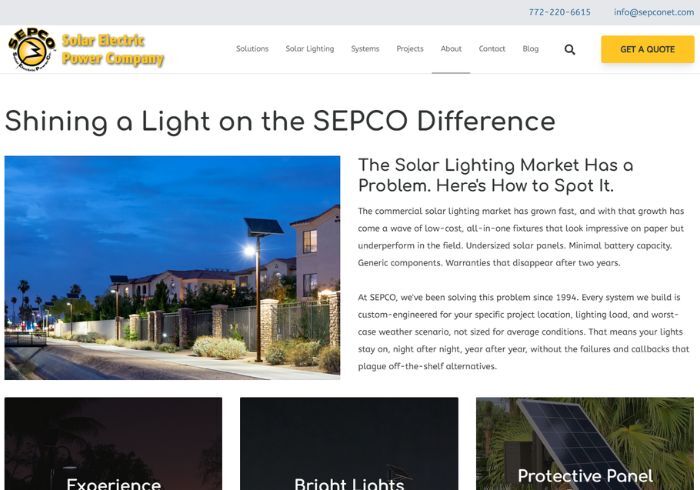
→ The SEPCO Difference — Side-by-side comparison of SEPCO systems vs. all-in-one commodity solar lights. Specifically addresses undersized panels, minimal battery, and short warranties that plague the low-cost market. Recommended reading before any spec conversation.
→ Why Use Commercial Solar Lighting — Top-level value proposition page covering energy savings, grid independence, and sustainability. Good reference for client presentations.
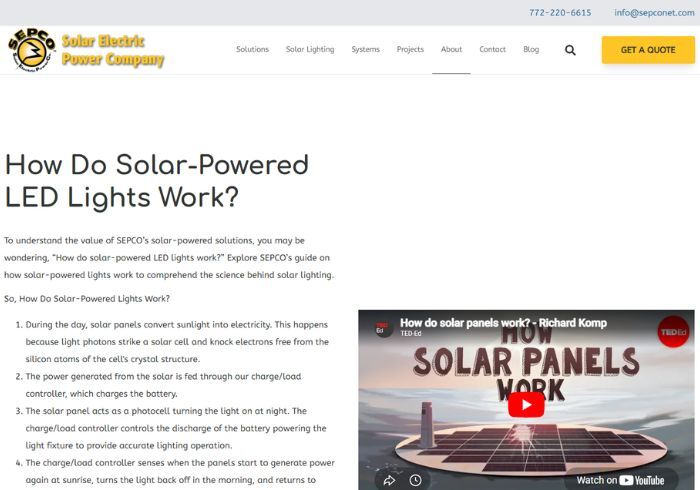
→ How Solar Works — Plain-language explanation of the solar power cycle — panel, battery, controller, fixture. Useful to share with clients or municipal stakeholders who are unfamiliar with off-grid systems.
→ FAQ — Frequently Asked Questions — SEPCO's own FAQ page covering system sizing, shading concerns, maintenance intervals, autonomy days, and fixture compatibility. Includes downloadable Design Guide eBooks.
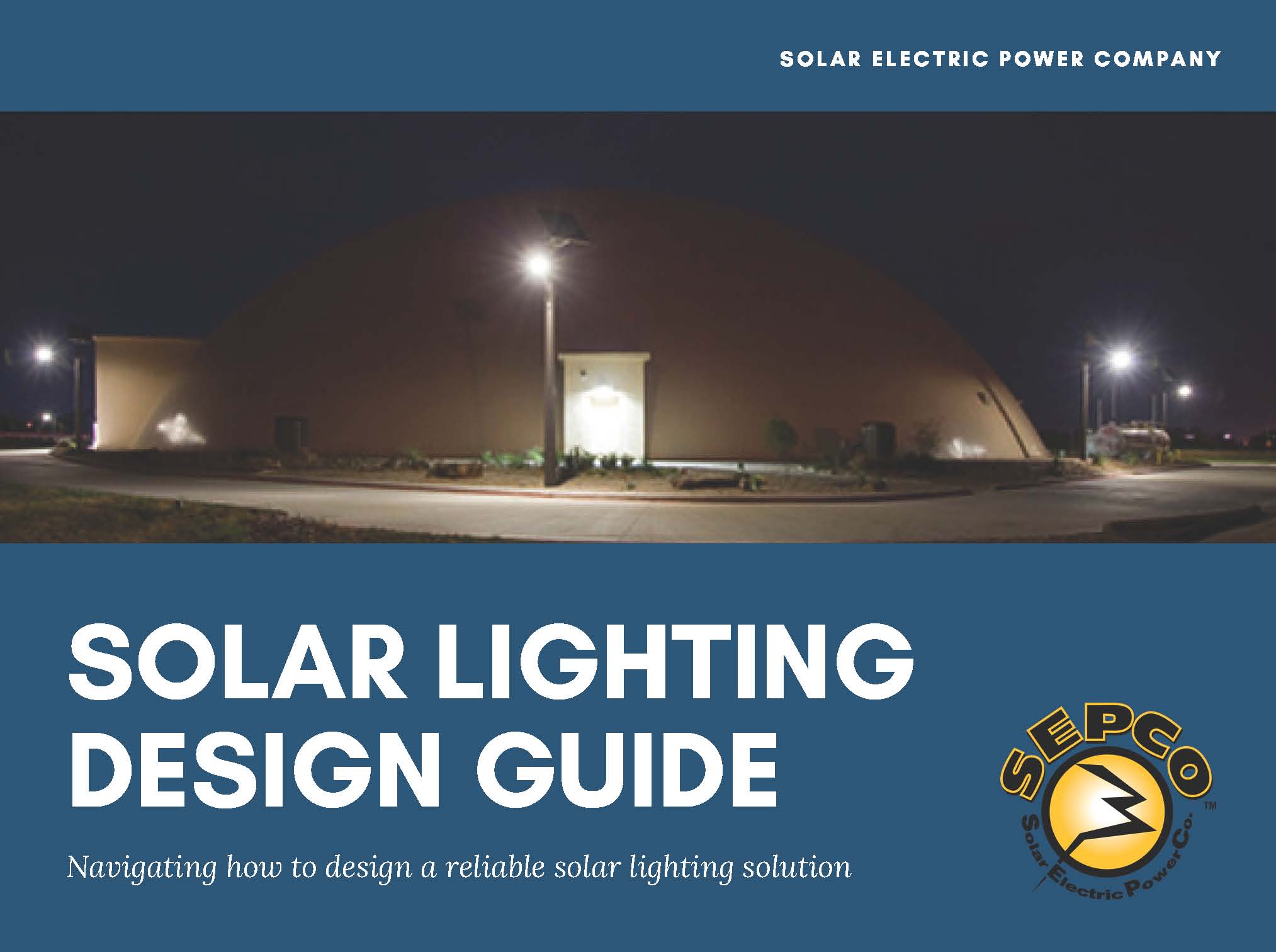
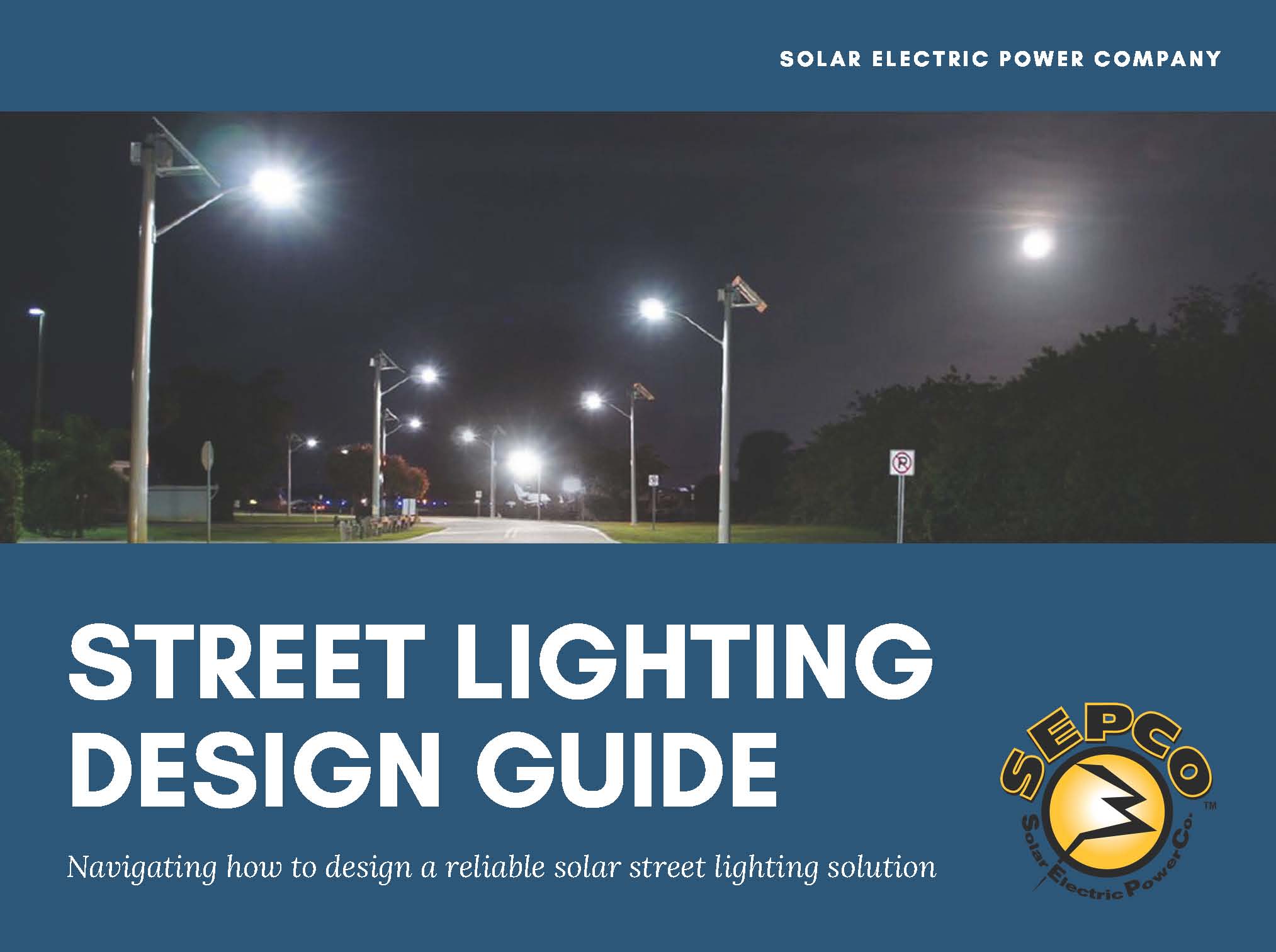
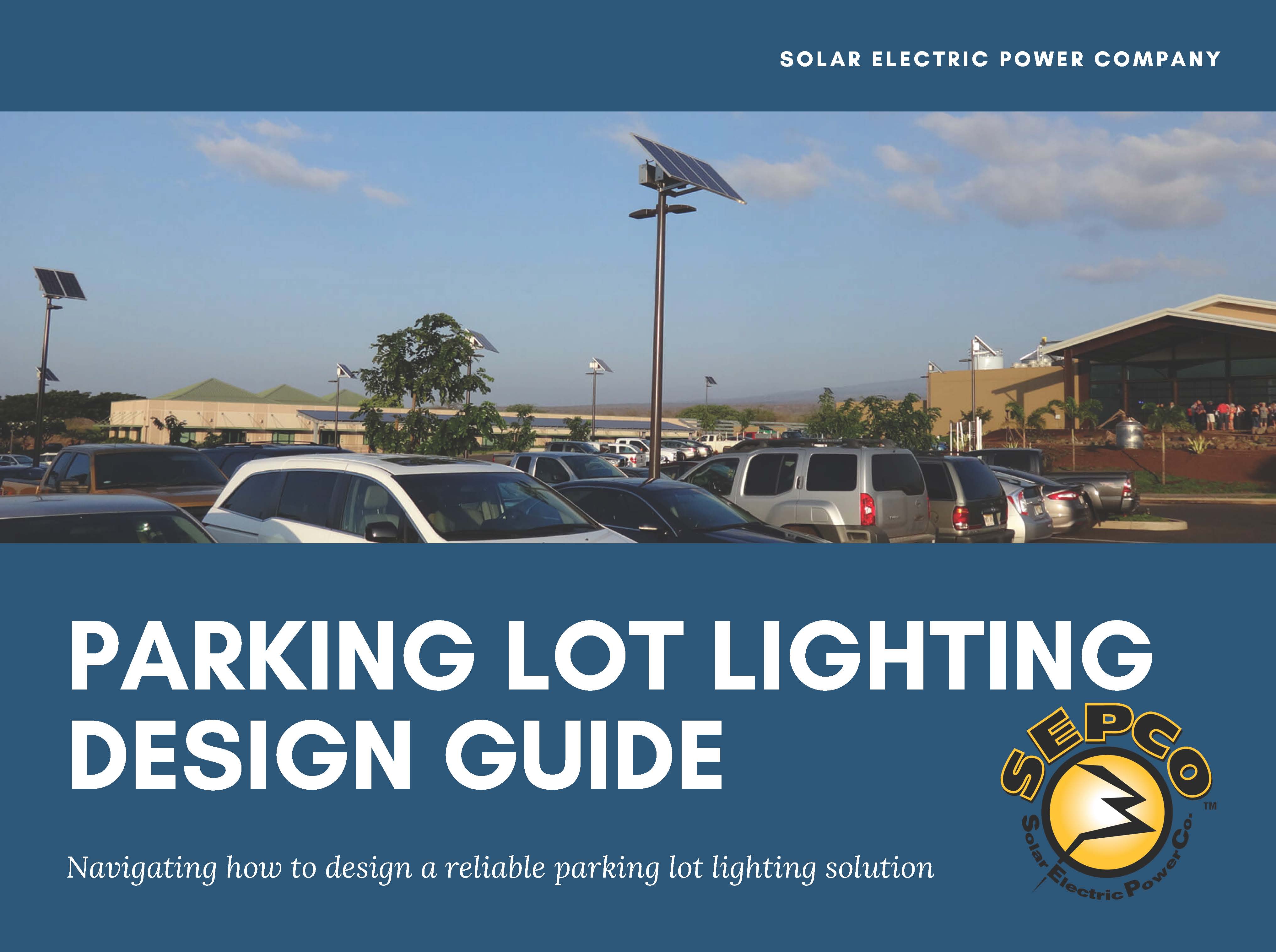
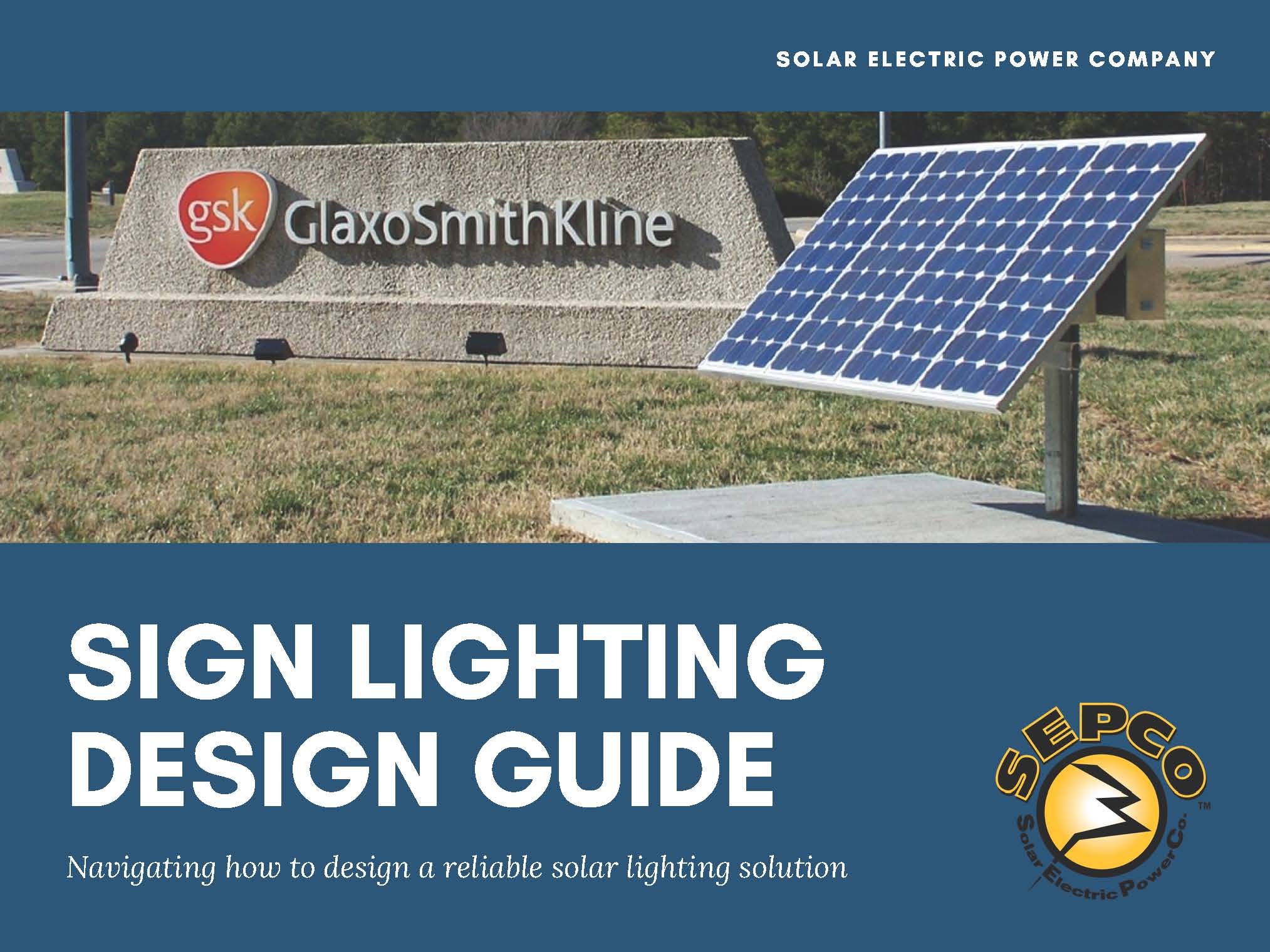
→ Solar Lighting Design Guide (Landing Page) — Hub for SEPCO's complete suite of design guides — Solar, Street, Parking Lot, Sign, Security, and Transit Lighting. Each guide is a downloadable PDF.
Solar Lighting Feasibility & Site Siting
How do I know if my project site has adequate solar resource for a reliable off-grid lighting system?
The key variable is your site's peak sun hours (PSH), the number of equivalent full-sun hours per day at your location and latitude. SEPCO pulls this data from the NREL National Solar Radiation Database (NSRDB) using your project's ZIP code. As a general rule, most of the continental U.S. has sufficient solar resource for off-grid lighting, including northern states; the system is simply sized differently for lower PSH locations. A site in Phoenix at 5.08 PSH requires a smaller panel array than the same load in Seattle at 1.28 PSH. We account for this in every proposal. If you have a site address, we can run a preliminary feasibility check and return a PSH value and estimated system size.
What are 'autonomy days' and how does SEPCO calculate them for a specific project?
Autonomy days (also called days of autonomy or backup days) refers to the number of consecutive days a solar lighting system can operate at full output without any solar recharge, running solely on stored battery energy. This is the core reliability metric for off-grid lighting, and it's the number that separates well-engineered systems from commodity products that fail in extended cloudy periods.
SEPCO sizes every system to a minimum of five autonomy days, with additional storage available for critical infrastructure applications. The calculation uses worst-case historical data for your project's latitude and season, not yearly averages. A system specified for Minneapolis is designed around December patterns for that latitude, not the annual mean. We use NREL data inputs and our in-house sizing methodology to generate this figure for every project before a proposal is issued.
Are there site conditions that would disqualify a location from solar lighting?
Yes, and we'll tell you upfront. Solar lighting is not the right solution for every situation. Disqualifying or significantly limiting conditions include:
Heavy persistent shading: Tree canopy, adjacent buildings, or structures that block the southern sky exposure for more than 30% of daylight hours create a system sizing problem that may be cost-prohibitive. We assess this using sun angle data for your latitude.
Very high fixture wattage: Applications requiring 400W+ fixtures (large six-lane highways, car dealership lots, sports lighting) typically cannot be solar-powered in a cost-effective, self-contained configuration.
Extremely high pole density in confined areas: In dense urban grids where pole spacing is 50 feet or less, the cost-per-pole for solar vs. trenching begins to favor grid-tied infrastructure.
For any borderline case, we run the numbers honestly. If solar isn't the right fit, we'll say so.
How does partial shading from trees or adjacent structures affect system performance?
Any shading during the solar charging window reduces the panel's energy harvest for that day. The design response depends on the degree of shading. Intermittent shading (morning or late afternoon only) can often be managed through additional panel capacity or battery reserve. Persistent mid-day shading is more problematic because it affects the peak charging hours.
When shading is a known site condition, SEPCO uses sun angle modeling for the project latitude to determine actual shading impact across seasons. In some cases, panel repositioning (side-mounting at a different angle or specifying a dual-panel configuration) can reduce shading exposure. In cases of severe or unresolvable shading, we will flag this in the proposal and recommend alternatives rather than proceed with a system that will underperform. This is a site assessment conversation we recommend having before schematic design is complete.
Solar Lighting System Design & Engineering
What information does SEPCO need to produce a complete system proposal?
A complete solar lighting proposal requires four inputs:
1. Project location (city/state or street address). This drives PSH calculation, worst-case night length, and wind load engineering.
2. Application type. Pathway, parking lot, street, security, sign, or other. This determines IES distribution type, mounting height range, and uniformity requirements.
3. Target light level. If you have an IESNA or municipal standard to meet, provide the foot-candle and uniformity ratio requirements. If not, we'll recommend appropriate levels based on application and adjacent use.
4. Operation profile. Dusk-to-dawn, partial night, or schedule-controlled dimming. This directly affects battery sizing and energy budget.
With these four inputs, our engineering team can produce a full photometric layout with your provided AutoCAD file (in AGI32), system sizing, fixture specification, and rough cost estimate. We typically turn this around in 48–72 hours.

Can SEPCO provide photometric analysis using AGI32 for plan submittals?
Yes. SEPCO's engineering team produces complete photometric lighting analyses using AGI32, the industry-standard photometric software used by electrical engineers and lighting designers across municipal and commercial practice. Our AGI32 output includes illuminance point-by-point grids, average and minimum foot-candle values, uniformity ratios (average:minimum and maximum:minimum), and pole layout drawings mapped to your site plan.
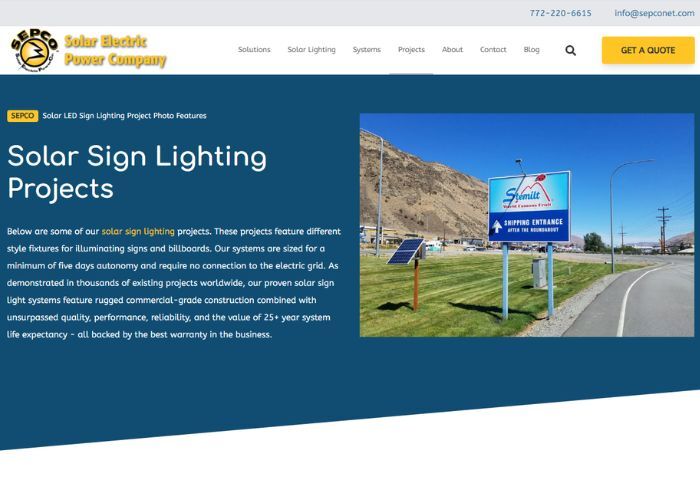
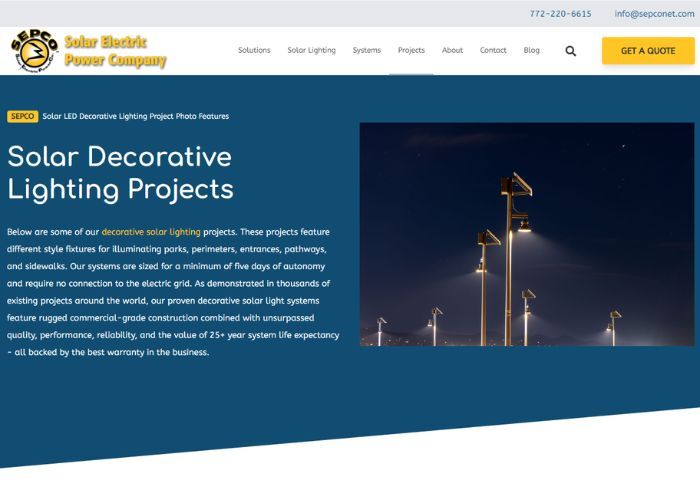
These deliverables are formatted for insertion directly into design development and construction document packages. If your electrical engineer has specific output format requirements, particular scales, legend formats, or title block standards, let us know and we'll do our best to accommodate. The photometric analysis is provided at no cost as part of the proposal process for qualified projects.
How does SEPCO handle wind load requirements? Are poles certified for hurricane zones?
All SEPCO solar light poles are engineered to meet or exceed local AASHTO wind load requirements for the installation location, with the full solar power assembly (panel, battery enclosure, and fixture) factored into the EPA (Effective Projected Area) and moment load calculation. Our standard systems are certified to withstand wind speeds of 150+ mph, which covers most ASCE 7 wind exposure categories including hurricane coastal zones.
For projects in ASCE 7 high-wind zones (Florida coast, Gulf coast, Atlantic coast, and similar), we specify poles with the appropriate certified wind load ratings. Project-specific structural certification documents are available upon request and for an additional fee, typically required for permit submissions in high-wind jurisdictions. These must be requested at the start of the project to be incorporated into the engineering package.
What pole materials and foundation types are available?
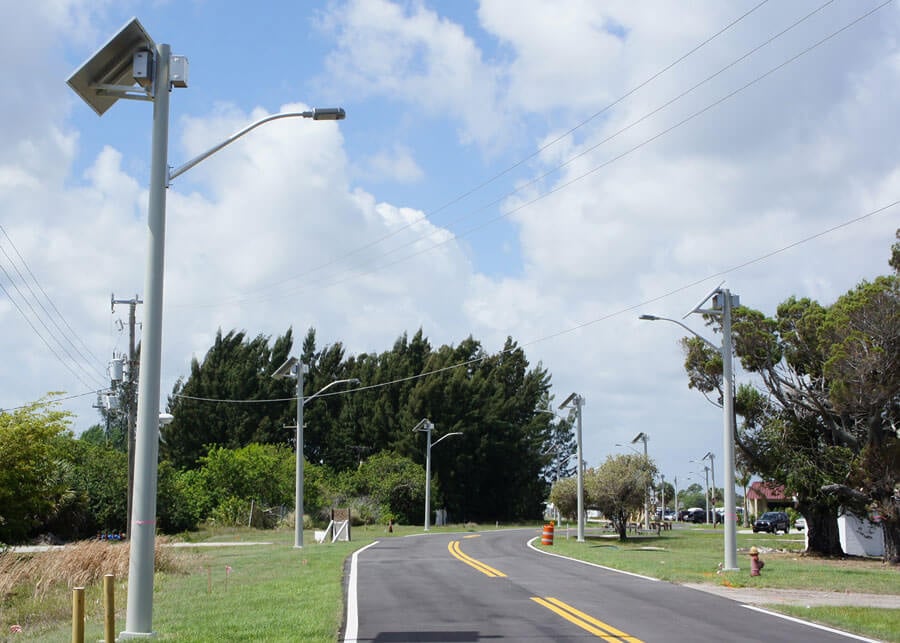
SEPCO offers solar light poles in steel, aluminum, fiberglass, concrete, and wood depending on the application, aesthetic requirement, and environmental conditions. For coastal or high-humidity environments, aluminum or concrete are preferred for corrosion resistance. For urban streetscapes where aesthetics are a primary driver, architecturally finished aluminum or steel poles with decorative base covers are available.
Foundation options include direct embedment, bolt-down base plate, transformer base, and helical pier (screw-pile) foundations. Engineered foundation design documents are available for projects for an additional fee and must be requested at the start of the project to be incorporated in the final design.
Can SEPCO systems be specified with adaptive lighting controls, such as dimming, motion sensing, or schedule programming?
Yes. SEPCO systems support a range of control options including dusk-to-dawn full output, scheduled dimming profiles (e.g., 100% output 6PM–11PM, 50% output 11PM–5AM, 100% at 5AM), and occupancy/motion-sensing boost modes. Importantly, any dimming profile specified on a SEPCO system is a performance enhancement, not a workaround for an undersized battery like with many other manufacturers, and our systems are sized to operate at full specified output for the full programmed duration without dimming.
This is a meaningful distinction from commodity solar lighting, where aggressive dimming is often used to mask insufficient battery storage. When you receive a SEPCO photometric analysis, the foot-candle values shown represent actual full-output performance at the programmed output level, not peak values that are only achieved for the first hour after dusk.
Solar Lighting Specifications, Codes & Compliance
How do I write a SEPCO specification that prevents low-cost solar substitution during the bid process?
This is one of the most practical questions an architect or engineer specifying solar can ask. The substitution risk is real: a properly engineered SEPCO system will almost always cost more than a commodity all-in-one product, and value-engineering substitutions can significantly degrade long-term performance.
To write a defensible spec, we recommend requiring the following performance criteria (rather than brand-naming the product, which can create bid protest exposure):
-
Minimum 5 nights of battery autonomy at specified full output
-
Panel wattage sized to location's worst-month peak sun hours (provide the NREL PSH value)
-
LED fixture with IES Type distribution appropriate to the application
-
AGI32 photometric calculations demonstrating compliance with minimum and uniformity requirements at the specified mounting height
-
AASHTO wind load certification for the installation ZIP code
-
US-manufactured product meeting BAA/BABA requirements (if applicable)
-
Battery warranty minimum 5 years, panel warranty minimum 25 years
This language locks out systems that cannot meet the engineering criteria. We can provide suggested specification language formatted for CSI Master Format structure upon request.
Do SEPCO systems meet IDA Dark Sky standards and Florida FWC turtle-friendly lighting requirements?
Many SEPCO fixture options are designed to comply with both International Dark-Sky Association (IDA) guidelines and Florida Fish and Wildlife Conservation Commission (FWC) sea turtle protection criteria. For dark sky compliance, we specify full-cutoff (Type 90° or greater) luminaires with no uplight component, appropriate CCT (typically 3000K or lower), and output levels calibrated to task illuminance rather than overlighting.
For FWC turtle-friendly certification in coastal Florida zones, we offer amber-spectrum LEDs (590nm peak) that are documented to be less disorienting to nesting sea turtles and hatchlings. SEPCO can provide fixture data sheets with IDA and FWC certification documentation for permit submittals in jurisdictions that require it. If your project is in a coastal overlay zone or adjacent to sensitive habitat, flag this at the start of design and we'll specify accordingly.
Are SEPCO systems compliant with Buy American Act (BAA) and Build America Buy America (BABA) requirements for federally-funded projects?
Yes. SEPCO solar lighting systems are manufactured at our Stuart, Florida headquarters and meet all BAA and BABA domestic manufacturing requirements. This is relevant for projects receiving federal funding through FHWA, HUD, EPA, EDA, USDA, or similar programs where Buy American provisions are standard grant conditions.
SEPCO is registered on SAM.gov with CAGE Code 1VYPO and maintains active federal contracting credentials. For projects requiring documentation of domestic origin, we provide manufacturer declarations confirming BAA/BABA compliance for each product category. This documentation should be requested at the start of the project and included in the procurement package.
Solar Lighting Performance, Reliability & Lifecycle
What is the expected component lifecycle and when should replacement be budgeted?
SEPCO systems are designed with predictable, budgetable replacement cycles for each major component:
-
Solar panels: 25-year linear power output warranty. Expected field life of 30+ years with typical degradation of 0.5% per year.
-
GEL batteries: 5–7 year design life under normal cycling. LFP (lithium iron phosphate) batteries, where specified, carry a 10-year design life at typical cycling depths.
-
LED fixtures: 50,000–100,000 hour rated life. At 4,000 hours of operation per year (dusk-to-dawn), this represents 12–25 years before lumen depreciation reaches the L70 threshold.
-
Control electronics and drivers: 5–15 years depending on environment. Sealed enclosures extend electronics life in harsh conditions.
All replacement components are budgetable as scheduled maintenance line items, not emergency replacements. Systems are designed with modular component access so individual parts can be serviced without removing the entire assembly.
What happens to the lights during an extended power outage or emergency? Is solar more resilient than grid-tied?
This is one of solar lighting's most underutilized selling points. A properly sized SEPCO system is completely independent of the utility grid, which means it continues to operate normally during utility outages; hurricanes, ice storms, infrastructure failures, or rolling brownouts. The system does not 'know' that the grid is down because it never draws from it.
For municipalities and agencies concerned about emergency preparedness, this is a meaningful infrastructure resilience argument: solar-lit pathways, parking lots, and roadways remain operational during disasters when grid power fails. This argument has particular resonance for healthcare campuses, emergency facilities, and critical infrastructure projects where lighting continuity is a safety and operational requirement.
How does performance compare between summer and winter in northern latitudes?
In northern latitudes, the winter challenge has two variables working against the system simultaneously: shorter days (fewer peak sun hours available for charging) and longer nights (more hours of battery draw required). SEPCO designs every system for this worst-case scenario, which for most of the northern U.S. falls in late December.
Specifically: we use the shortest peak sun hours of the year for the project latitude as our sizing input, combined with the longest night of the year as our load duration. This ensures the system is over-built for summer and perfectly sized for winter worst-case. A system designed this way will actually perform better in summer than in winter, but it will never underperform in winter because that's the baseline it was designed for.
The key question to ask any solar vendor is: 'What month's PSH values did you use to size this system?' If the answer is 'annual average,' the system is undersized for winter.
Can SEPCO systems be retrofitted onto existing pole infrastructure to avoid full pole replacement?
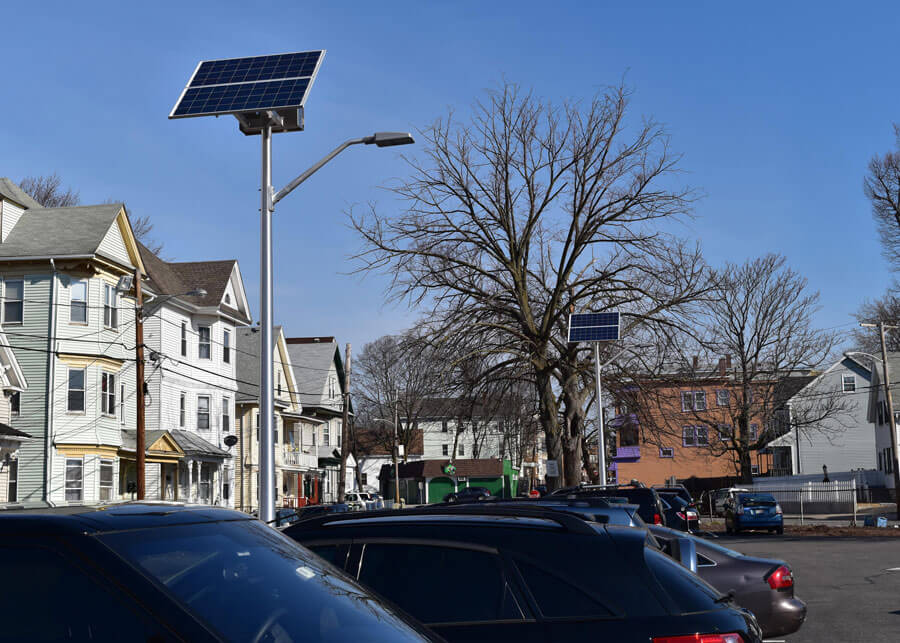
In limited cases, yes. Retrofitting a solar power assembly onto an existing pole requires the existing structure to support the additional wind load created by the solar panel array; typically 4 to 25 square feet of EPA and 150 to 700 lbs of additional weight. Most existing utility-grade and standard street light poles are not engineered for this additional load and require structural engineering review before retrofit can be confirmed.
In practice, successful retrofits are most common on robust wood utility poles and heavy-gauge steel or concrete commercial poles. Older aluminum streetlight poles typically require replacement. SEPCO can assess retrofit feasibility if you can provide the existing pole specification (wall thickness, pole height, embedment depth, and original EPA rating). For new installations, specifying SEPCO solar poles from the start is almost always more cost-effective and structurally reliable than attempting a retrofit.
Solar Lighting Procurement, Pricing & Process
How does pricing for a SEPCO solar lighting system compare to grid-tied alternatives on a per-fixture and total-project basis?
The accurate comparison requires looking at total installed cost and lifecycle cost; not just the fixture purchase price.
On a per-fixture purchase price, a SEPCO solar system typically has a higher upfront cost than a grid-tied fixture alone, because the solar system includes panel, battery, controller, and enclosure in addition to the luminaire.
However, on a total installed cost basis (including trenching, conduit, wiring, electrical tie-in, and utility connection), solar is frequently cost-competitive or less expensive, particularly for sites where electrical infrastructure is not already in place, where trenching costs are high due to paving, landscaping, contamination, or distance from the grid.
On a 20-year lifecycle cost basis, solar almost always wins: zero utility bills, near-zero maintenance costs, and no utility rate escalation exposure over the asset's life.
Can municipalities and public agencies purchase SEPCO systems through cooperative contracts without a competitive bid process?
Yes. SEPCO is an approved vendor on multiple cooperative purchasing contracts that allow qualifying government entities to purchase without conducting a separate competitive bid process. Active cooperative vehicles include:
-
HGACBuy (Houston-Galveston Area Council)
-
BuyBoard (National Purchasing Cooperative)
-
Pavilion
-
Allied States Cooperative (ESC19)
-
791 Purchasing Cooperative
-
Region 18 Education Service Center
-
McAllen ISD
Cooperative purchasing is available to municipalities, counties, school districts, universities, transit authorities, and most other public entities. To purchase through a cooperative, contact your SEPCO representative with the cooperative you're enrolled in and we'll route the order through the appropriate contract vehicle. This typically reduces procurement timelines by 4–8 weeks compared to a public bid process.
How long does the process take from initial specification to order to delivery and installation?
Typical timeline for a commercial or municipal solar lighting project:
-
Photometric analysis and system proposal: 48–72 hours after site information is received
-
Proposal revision and approval: typically 1 week - 6 months depending on client review cycle
-
Engineering and fabrication lead time: 6–10 weeks for standard systems; longer for very large orders or highly customized configurations
-
Shipping and delivery: 1–2 weeks depending on destination
-
Installation: solar poles install without electrical sub coordination, typically reducing installation duration by 30–50% vs. grid-tied
For projects with tight schedule constraints, contact us early in the design phase. We can often expedite fabrication for critical path projects. Projects pursuing cooperative purchasing contracts on a tight timeline should also engage us early to confirm contract vehicle availability.
Latest Collection
Liability Matters: Reducing Hazards with Proper Illumination
Proper lighting is not just a design flourish or an energy line item; it is a life‑safety system that materially reduces slips, trips, falls, vehicle...