Contents
Nighttime safety on school and university grounds is non‑negotiable. Evenings and late nights bring classes, rehearsals, practices, study sessions, and campus jobs. When visibility drops, students and faculty should still feel confident moving between dorms, libraries, lots, and “third spaces” such as courtyards and outdoor study areas.
Thoughtful outdoor lighting is one of the most visible and effective ways to create that confidence. Yet trenching for new wiring, upgrading panels, and pulling permits can stretch capital budgets and timelines. Solar area lighting changes the equation by delivering high‑quality illumination where it’s needed most, without the infrastructure burden, while advancing sustainability and resilience goals.
If you’re beginning to explore options, start with SEPCO’s overview of how schools deploy solar lighting across pathways, lots, and common areas; it’s a practical primer on planning and outcomes for education environments. Why Solar Lighting is a Go‑To Option for School Campuses. For a broader spectrum of applications and design insights, SEPCO’s Solar Area Lighting topic hub is a solid reference to keep handy as you evaluate project scopes and tradeoffs.
Safer Movement, Fewer Dark Zones, and Better Oversight
Campus safety teams know lighting has an outsized influence on behavior and perception after dark. A growing body of research confirms what many facilities leaders intuit: better lighting correlates with fewer nighttime offenses and greater willingness to use public spaces. In Philadelphia’s ongoing citywide LED streetlight upgrade, researchers observed a statistically significant decline in outdoor nighttime crime after tens of thousands of fixtures were modernized, including a notable reduction in gun violence where upgrades occurred during the study period. Rigorous experimental work in New York City public housing showed similar patterns; randomized deployments of additional lighting reduced nighttime “index crimes,” offering rare causal evidence that illumination can deter offenses when deployed tactically.
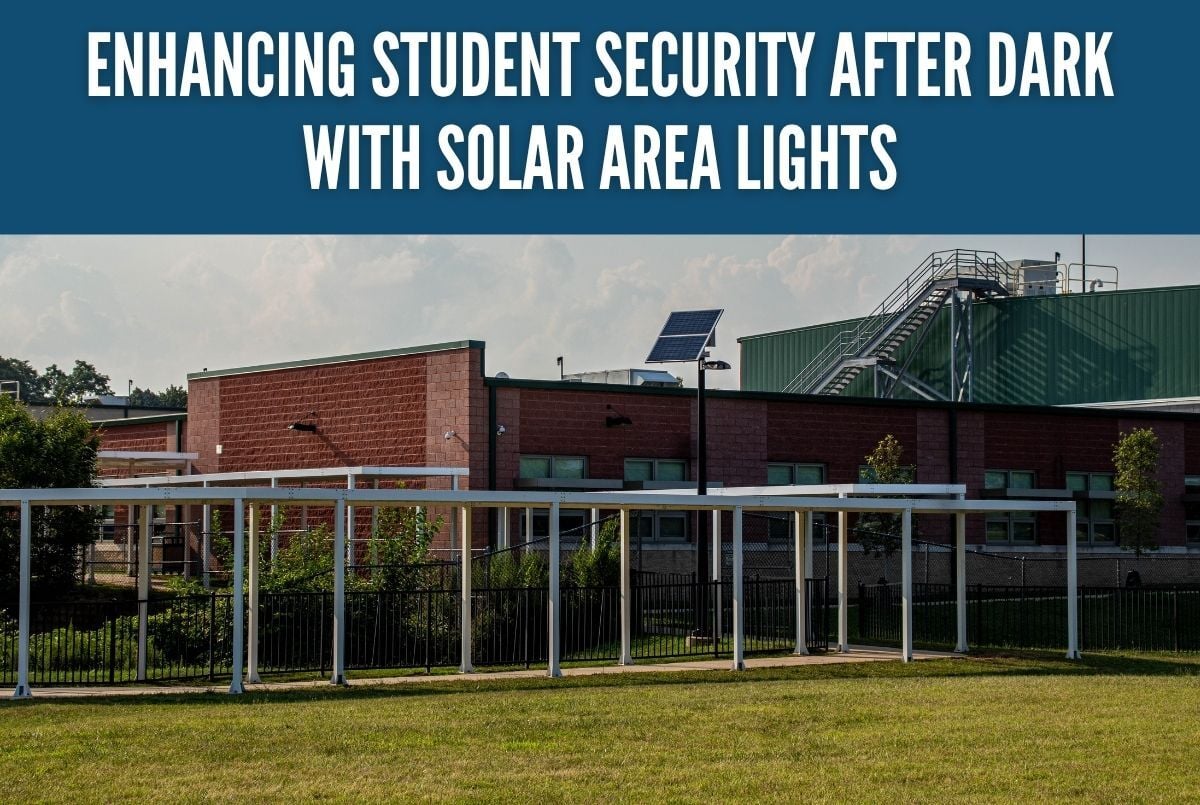
For campuses, those findings translate to simple, actionable guidance: illuminate the routes people actually take and remove shadow pockets that encourage avoidance. Solar area lights are particularly effective for filling coverage gaps across remote parking lots, back‑of‑house service paths, intramural fields, and newly developed parcels where extending grid power is cost‑prohibitive. Because the power is on the pole, your team can place light exactly where it’s needed, reduce blind corners, and support patrol visibility without trenching. For examples of education‑specific deployments and typical siting strategies, see SEPCO’s solutions page for School & College Campus Projects.
A More Welcoming, Inclusive Nighttime Campus
Safety is the baseline. The next layer is belonging. When walkways, plazas, quads, and outdoor study zones feel bright and welcoming, students stay longer, collaborate more, and treat campus as a shared place, even after sunset. Transportation and safety research backs this up from the pedestrian perspective: federal guidance highlights that well‑designed lighting improves nighttime visibility and helps reduce crashes for vulnerable road users, particularly when crosswalks and intersections are thoughtfully illuminated. Insurance Institute for Highway Safety studies further show that illuminated crosswalks and triggered beacons make drivers far more likely to yield after dark, a reminder that targeted light not only changes how spaces feel but how people drive and move through them.
Solar makes these improvements easier to implement. You can add light to “sticky” third spaces, outdoor seating clusters near libraries, student centers, and residence halls, without upheaval to hardscape or landscaping. Motion‑adaptive profiles let you keep a comfortable base level of illumination and step up to full output when activity is detected, striking a balance between comfort, stewardship of the night sky, and battery autonomy. Research and design guides on adaptive lighting indicate that sensor‑based, context‑aware systems can support security aims while reducing energy use and light spill when areas are empty.
If you’re considering third‑space activation specifically, SEPCO’s planning pieces on transforming public spaces and maximizing parks and playgrounds are useful analogs for campus quads and commons, mapping how light levels, distribution, and controls intersect with the way people actually gather after dark. Explore these ideas in SEPCO’s posts within the Solar Area Lighting collection.
Lower Operational and Maintenance Costs From Day One
Every kilowatt‑hour you don’t buy is a budget win. LED technology has fundamentally reshaped outdoor lighting’s energy and maintenance profile, and that’s before you remove electricity costs entirely with solar. The U.S. Department of Energy’s solid‑state lighting program has long projected that LEDs would dominate high‑lumen, long‑hours applications like area and roadway lighting, precisely where campuses log many of their after‑dark hours. Those same forecasts attribute massive national energy savings to LED adoption and controls at scale, underscoring why facilities teams see measurable reductions the moment they convert legacy sources.
On the maintenance side, solar area lighting leverages long‑life LED luminaires and sealed, high‑cycle batteries to meaningfully reduce service calls compared to legacy HID systems. When you avoid trenching, conduits, and panel upgrades, you also avoid the “hidden” lifecycle costs that come with underground infrastructure repairs. For a side‑by‑side view of grid‑tied versus off‑grid considerations and an explanation of why sizing and autonomy matter for reliability, SEPCO’s articles on autonomy and system right‑sizing are great refreshers inside the SEPCO Blog.
Sustainability that Shows Up on Scorecards and in Daily Life
Sustainability commitments are as central to higher education as academic outcomes. By shifting campus lighting to solar, you directly lower scope‑2 electricity consumption and associated emissions, while also reducing light pollution when you select appropriately shielded optics and smart controls. Many institutions track these outcomes in AASHE STARS; lighting efficiency and energy use intersect with Operations credits, and safety and well-being intersect with Planning & Administration. The current STARS 3.0 technical manual and help center resources clarify where energy, emissions, and health & safety practices appear in reporting.
You can also align with LEED‑style exterior lighting practices that limit uplight, glare, and trespass by following BUG ratings, model lighting zones, and control strategies, principles outlined in USGBC’s Light Pollution Reduction guidance and related practitioner resources. For performance baselines and design criteria, consult Illuminating Engineering Society (IES) recommended practices for roadway and parking facilities lighting; these documents are widely referenced in campus standards and RFPs.
What To Look For in Campus‑Grade Solar Area Lights
Reliability stems from a few critical design decisions. First, ensure the system is sized for your latitude and expected cloudy‑day sequences; autonomy targets of multiple nights provide resilience during poor weather. SEPCO’s planning content explains why autonomy cushions are vital for uninterrupted operations. Learn more about solar lighting autonomy and why having a minimum backup is important with off-grid solar systems.
Second, specify batteries built for nightly cycling and safety. Proven technologies such as lithium iron phosphate (LiFePO₄), sealed GEL lead‑acid, and other deep‑cycle chemistries (including AGM and advanced lead‑acid variants) are commonly used in commercial solar lighting, each offering different tradeoffs in cost, longevity, and operating constraints. LiFePO₄ has emerged as a leading option due to its thermal stability, long cycle life, and consistent performance across temperature swings, while GEL batteries remain valued for their sealed construction, vibration resistance, and predictable behavior in lower‑duty applications, making battery chemistry selection a key driver of total cost of ownership and risk for facilities teams.
Third, use adaptive controls to balance experience and efficiency. Motion‑responsive dimming, dusk‑to‑dawn scheduling, and remote monitoring not only conserve stored energy but also support CPTED‑aligned visibility without over‑lighting inactive spaces. Evidence syntheses and field studies point to security and energy benefits from sensor‑based strategies when appropriately commissioned.
Finally, validate photometrics against campus standards. Reference IES recommended practices for target illuminance and uniformity, then choose optics that place light only where it’s needed to respect dark‑sky goals and ecological sensitivity.
A Smarter Path to Safer Nights and Stronger Community
Solar area lighting gives schools and universities a practical, future‑proof way to make nighttime movement safer, extend the usable day for wellness and extracurricular life, and steward both budgets and the environment. It’s fast to deploy where growth is happening, resilient during grid disruptions, and flexible as campus patterns change.
If you’re ready to scope a project, SEPCO’s education page walks through application‑specific considerations and typical configurations for pathways, parking, and recreation spaces, along with procurement starting points tailored for facilities and maintenance departments. Solar LED Lighting for School & College Campus Projects For additional context across applications and design questions, explore SEPCO’s curated Solar Area Lighting guides.